The material
A gem, grown
Moissanite is silicon carbide. It was first identified in 1893 by Henri Moissan in the debris of a meteorite strike in Arizona, and named for him. What he found occurs in nature only in traces — far too small to cut — so every stone sold as jewelry today is grown in a lab.
That is the honest version, and it is also the interesting one. Grown stones are not a compromise here. They are how a stone of this clarity reaches your hand at all.
Questions, answered
The stone, explained
Everything we know about the material, said plainly. If a question is missing, write to us and we will answer it here.
The stone
What is moissanite?
Silicon carbide, grown in a lab. It occurs in nature only in traces, far too small to cut, so every stone sold as jewelry is grown.
How is it grown?
Silicon and carbon are combined under heat and pressure until a crystal forms, then the rough is cut and polished like any other gem. The process dates to the 1990s. Nothing is dug out of the ground.
So is it synthetic, or fake?
Neither word fits. It is a real gem with a real crystal structure, made above ground rather than found below it. We say lab-grown, because that is what it is. We do not say simulant or faux, because it is not imitating anything — moissanite is its own material.
Light
Why does it sparkle the way it does?
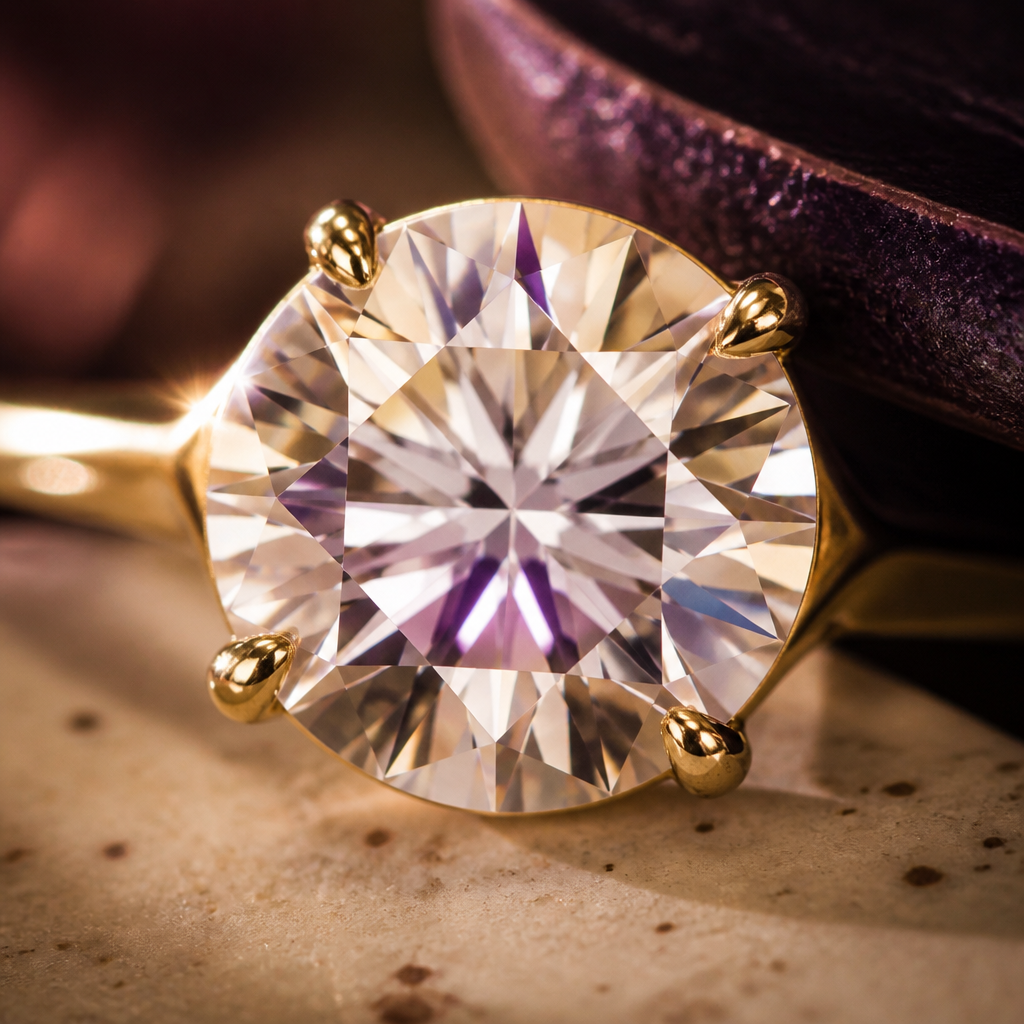
Two separate properties. Brilliance is how much light a stone returns; moissanite has a refractive index of 2.65, against 2.42 for diamond, so it bends and returns more of it. Fire is dispersion — how far the stone splits white light into colour. Moissanite disperses more than diamond, ruby, sapphire or emerald, which is why you see flashes of colour rather than only white flash.
Can people tell it apart from a diamond?
Under close attention, sometimes. The tell is the colour: moissanite throws more rainbow fire, especially in direct light and larger sizes. Some people choose it for exactly that reason. We would rather you know than be surprised.
Is it the same as a lab-grown diamond?
No. A lab-grown diamond is carbon and is chemically identical to a mined diamond. Moissanite is silicon carbide — a different material, with more fire and slightly less hardness. Different gem, not a cheaper version of the same one.
Wearing it
Will it last?
It measures 9.25 on the Mohs scale. Diamond is 10, sapphire 9. In practice that means it resists the scratching that dulls softer stones, and it is suited to daily wear rather than occasional wear.
Does it cloud or lose its colour over time?
No. The colour is inherent to the crystal, not a coating, so there is nothing to wear off. What dulls any stone is a film of soap, lotion and skin oil on the facets, and that washes away.
How should I care for it?
Warm water, mild soap, a soft brush. Rinse and let it dry. Remove it before swimming, before the gym, and before applying lotion — not because it is delicate, but because buildup is what takes the fire out.
Choosing
Why are sizes given in DEW rather than carats?
Moissanite is about 10% less dense than diamond, so at the same physical size it weighs less. A 6.5 mm round stone weighs roughly 0.88 carats but sits on the hand like a one-carat diamond. Quoting the raw carat weight would understate the size; quoting only the diamond figure would overstate the weight. So we list both — the millimetre measurement and the diamond equivalent weight.
What do the colour grades mean?
Moissanite is graded on a scale based on the GIA diamond colour scale. Colourless is the D–E–F range, near-colourless G–H–I, and below that stones carry a visible warm tint. Our stones are colourless unless a piece says otherwise.
How do I judge quality?
The same four things as any gem: cut, colour, clarity and size. Cut matters most — a well-cut stone returns light evenly across the whole face, and a poorly cut one has dead spots no amount of clarity will fix.
Which shape should I choose?
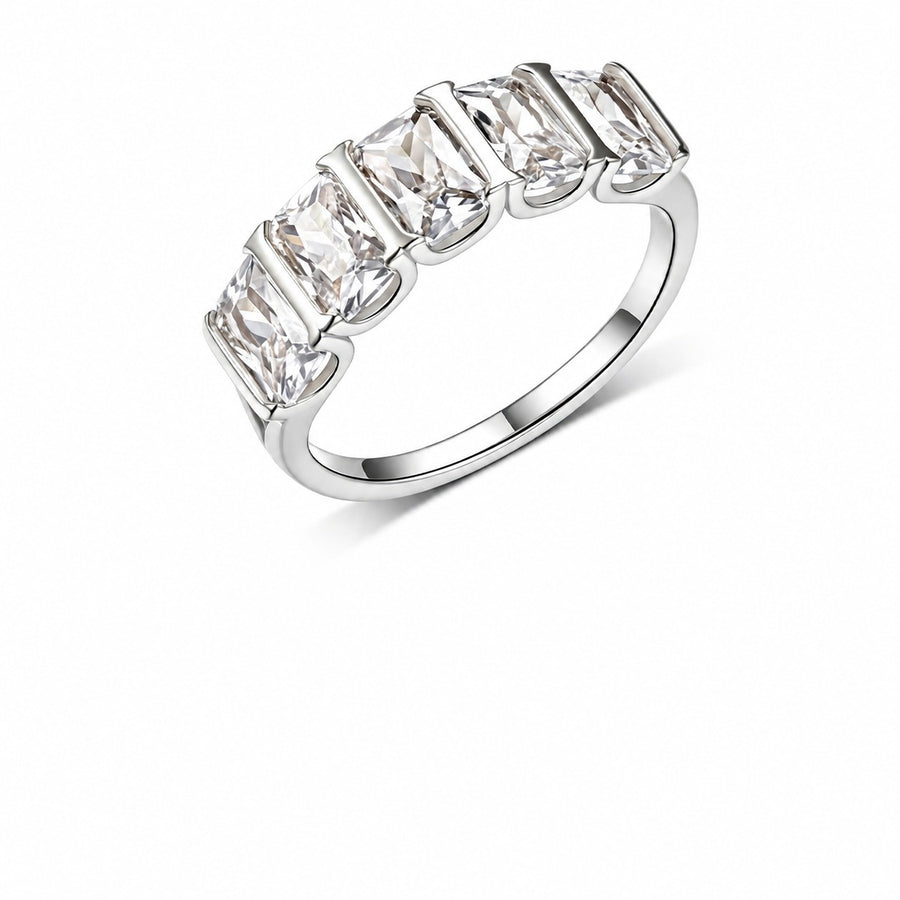
Round brilliant returns the most light and is the safest choice. Elongated cuts — oval, pear, marquise — look larger for the same weight and lengthen the finger. Step cuts like emerald and asscher trade sparkle for clarity of line, and show inclusions more readily.
Your order
What comes with the piece?
A GRA report stating the stone specifications. It is a supplier-issued report, not an independent laboratory grading — we would rather name it accurately than imply more than it is.
What metal are the settings?
925 sterling silver at present. Each piece lists its metal in the specifications.
What if it is not right?
Return it within thirty days of delivery, unworn and in its original packaging, and we will send you a prepaid return label. To exchange, return the piece and place a new order. The full terms are in our returns policy.
Every cut we carry